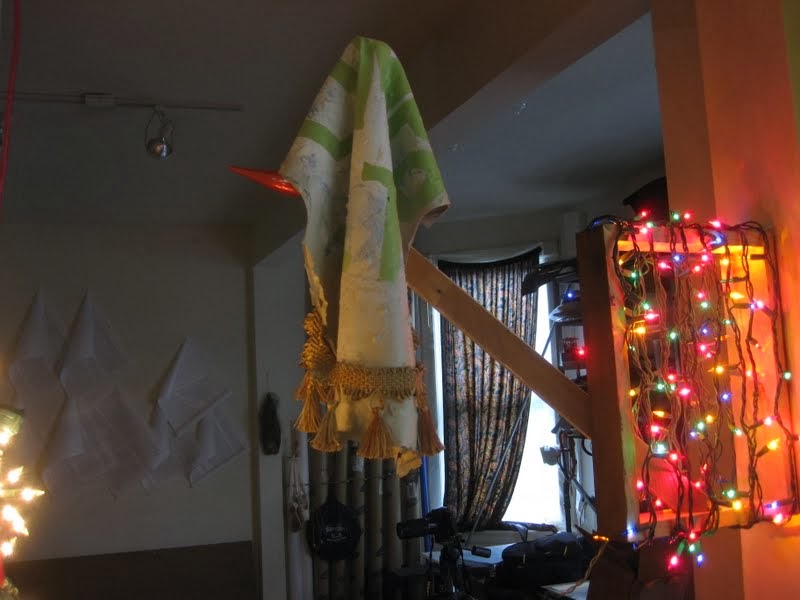
Your Christmas season just got a little more wonderful: I am hereby officially announcing The online broadcast of the Official Lighting of the 2010 Christmas Thing strait to your living room - or where ever else you can access it. This momentous event which will be happening here at Kamp Maykr in Beacon, NY will be streamed LIVE online to the furthest corners of the globe at www.christopheralbert.com .
For the last few years at Christmas, I've been creating these assemblage/sculpture/holiday decoration contraptions that I've affectionately named the Christmas Things.
If in looking at these things you don't quite get the spirit of the thing, let me explain this way: the Christmas Thing embodies my undying fondness of the season which has been informed by my mom's unmitigated passion for all things Christmas. It also entails my perplexity at the fixation we have of very specific, visual traditions......Mix those aspects with an ambition to out-mundane and out-banal that televised yule log, and you've got yourself a Christmas Thing.
And now we're sharing the experience of the Christmas Thing with living rooms around the world. This online broadcast will provide an added shot of good cheer, good neighborliness, and hopefully some good banter. Be sure to tune in to www.christopheralbert.com at 7pm Eastern Standard Time on Sunday December 19 to share in the making of memories and maybe a little history.
I vow not to waste your time - for too long.
Stay tuned for details as they develop.
Showing posts sorted by relevance for query christmas thing. Sort by date Show all posts
Tuesday, December 14, 2010
Oh Holy Mother of all Christmas Things!
Sunday, December 25, 2011
Oh Christmas Thing 2011
This year's Christmas Thing was late in developing, but alas, it has come. Inspired by the depiction of the holiday classic Hollywood films, this piece is silvery black and white....save for a string of paper balls that feature the hints of hues from the weekly store inserts which clog our mailbox every Wednesday. The original versions of films like Christmas in Connecticut, The Bishop's Wife, and Meet John Doe embody such a warmth and lushness of the xmas moment in their monochromatic renditions that the colors of the greenery, ornaments and baubles are realized in the viewer's own perception of the scene.
I'm not claiming that this monochromatic Thing has any of those powers....it's really just an homage.
One thing that it does have going for it is that it has a kinetic potential, as is demonstrated in the video below:
Friday, December 21, 2007
Oh Christmas Thing, Oh Christmas Thing.
Since I've been on my own, I've never had a Christmas tree. I love the season and my nostalgia for it seems to grow every year, but my experience of it is pretty internalized, and this has continued since I've been living with Angelika. We don't do much for Christmas generally, and usually drop out of the broader xmas machinations whirling around us, finding a serene corner in which to pass the holiday.
I love the smell that xmas trees and garland bring into the home, and the most that we've done consistantly decorating-wise is stringing up some natural garland, and trying to keep the cat from constantly eating and puking up the stuff.
I very nearly bought a tree, and I was envisioning the compositional potential of christmas lights. But putting all that together from scratch on short notice was more than I wanted to commit to, so I improvised and utilized what was on hand.
Thereby was born, The Christmas thing.

I strung the garland and colored lights around a contraption that I had built to support a sculpture that is in progress, and was originally intended for possible inclusion in the SOTT exhibit in November. Unfinished, the plaster sculpture, which is inspired by the graceful tendrils of ligament, blood and flesh flowing from Medusa's decapitated head in Benevenuto Cellini's sculpture, has assumed the mantle of holiday significance.
I think I've discovered my special holiday tradition. Look ahead for future renditions of new and varied Christmas Things in the years to come.
I love the smell that xmas trees and garland bring into the home, and the most that we've done consistantly decorating-wise is stringing up some natural garland, and trying to keep the cat from constantly eating and puking up the stuff.
I very nearly bought a tree, and I was envisioning the compositional potential of christmas lights. But putting all that together from scratch on short notice was more than I wanted to commit to, so I improvised and utilized what was on hand.
I strung the garland and colored lights around a contraption that I had built to support a sculpture that is in progress, and was originally intended for possible inclusion in the SOTT exhibit in November. Unfinished, the plaster sculpture, which is inspired by the graceful tendrils of ligament, blood and flesh flowing from Medusa's decapitated head in Benevenuto Cellini's sculpture, has assumed the mantle of holiday significance.
I think I've discovered my special holiday tradition. Look ahead for future renditions of new and varied Christmas Things in the years to come.
Saturday, December 27, 2008
Oh Christmas Thing 2008
The Christmas season is waning. Though not at home right now, before leaving I snapped a few photos of this year's version of the Christmas Thing(s).
Not particularly adventurous, these quick contraptions were destined for more development......which never happened......exhibit the ad hoc sloppiness inherint in so much of the Christmas aesthetic. I fully expect next year's Christmas Thing to be distinguished in its removal from the typical seasonal look. Studio 360 solicited a proposal for a redesign of xmas which illuminated some of my original, and has me thinking of a much more concious and provocative offering for next year.
Thursday, December 24, 2009
Oh Christmas Thing 2009
Christmas decorating came early and inadvertently this year. Shortly after my open studio in Sept, I did some shuffling here, a little shifting there and before I knew it, voila!, this year's Christmas Thing was very magically born. It's a good thing too. I knew after last year that I needed to step away from the crutch of garland and lights to formulate my annual yuletide alter of the mundane. Although I adore the scent of real garland, and real Christmas trees, I needed to go deeper to formulate the emblems of my Christmases to come. This year's specimen is a real contender in my mind.
As you can gather from this and previous years' Christmas Things, I don't necessarily strain myself in the fabrication of these yuletide alters. I'm no Clark Griswold.
But as with any other expression of seasonal cheer, these pieces elevate some designated niche filled with any ordained collection of items to a position that is worthy of gazing upon and projecting upon, any personally held notions of peace, family, giving, or crass commercialization that one attributes to this festive season.
These amalgamations and the spirit with which I view their creation are as dear to me as any of those memories of the natural or artificial, flocked or not Christmas trees, garlands, tangles of lights and copious amounts of baked goodness of my Christmases past.
There's much about the Christmas season from which I have worked to sequester myself, but those aspects that I do relish; the atmosphere (physical, ethereal, and nostalgic), the taint of expectation, the sense of specialness that is attributed to certain gestures be they grand or not are the things I respond to. Those are the abstractions (the good things) formed at the fringe of this massive stress-filled hustle-bustle, overindulged merchandised moment. And for me, for this moment, these Ritz boxes, that flattened Miller Lite 6 pack carrier, that polka dot sunglass case I found on the street, that stack of cardboard pallet feet from the packaging of our Ikea sofa and that spiral of Astroturf scrap are all imbued with those wonderful notions that waft in on gentle holiday currents.
Labels:
Christmas Thing,
Holiday Decor
Location:
Beacon, NY 12508, USA
Sunday, December 19, 2010
Oh Christmas Thing 2010
To aggrandize the Christmas Thing with a plethora of photos from multiple angles goes against the existenstial raison d'etre that rests at its core. Poorly lit, blurry snaps of the piece leaving one unsure of what one is seeing, has been de rigeur in past years which seems to be the way it should be.
But since the image quality of the online feed is even more indistinct, I thought I'd throw some bones for anyone who wanted to get the gist of what they're seeing.
So my plan is to stream the Christmas Thing Feed every evening (as long as I'm home to do it) until 10pm through Christmas Day.
But since the image quality of the online feed is even more indistinct, I thought I'd throw some bones for anyone who wanted to get the gist of what they're seeing.
So my plan is to stream the Christmas Thing Feed every evening (as long as I'm home to do it) until 10pm through Christmas Day.
Wednesday, December 24, 2014
Oh Christmas Thing 2014
![]() |
| Christmas Thing 2014, twigs, plastic ornaments |
This year's Christmas Thing is small, measuring just over 12" tall, yet it carries a rugged elegance on those delicate legs.
Monday, January 21, 2013
Oh Christmas (no)Thing 2012: B-E-A-S-T-(IE), Find out what it means to me
For the first time in five years, the KAMP MAYKR household was not outfitted with its customary Christmas Thing. With my return from Geneva coming so close to the holiday, and my attention drawn to reflecting on that experience, I simply couldn't get the job done.
However, to make up for the lack of a xmas assemblage, I want to share a discovery I made which I think may have an impact on current Christmas scholarship.
In the days leading up to - or immediately following Christmas this year, I was at the gym, working up a sweat on the stair step-py machine while watching a 2009 rerun of SNL. During the Weekend Update segment, a photo of a fur-wrapped Aretha Franklin was shown, accompanied by a punchline about her being eaten by a bear.
I recognized the image immediately as being directly related to the mural restauration-gone-awry that has come to be known as Beast Jesus. Last Summer in Zaragosa, Spain, Cecilia Gimenez, in an effort which would bring the issue of art restoration and conservation to the consciousness of much of the world, sought to "repair" the damaged mural of Christ entitled Ecco Homo painted by Elias Garcia Martinez in around 1930.
There must be something mysterious and magical afoot. The uncanny likeness between the two images, the relation to the sacred in both (the mural's depiction of Christ in a church, Aretha's appearance occurring at that most sacred of Christmas observations; the lighting of the Rockefeller Center Christmas tree, in 2009). Aside from the conscious internet memes, might we inadvertently see more images of this nature? It all makes me think that something greater was at work when Mrs Gimenez put brush to mural last year.
Perhaps the one of the greatest painterly fuck ups in history might really be the primitive stirrings (channeled through an 80 yr old Spanish woman) of a more profound vision/message of the divine.
A cursory search online makes me believe that this connection has gone unnoticed until now, and that's why I've decided to publish my finding now. I don't know what it means, but I leave it to those so inclined to pursue the trail which may well advance the quest for the elusive true meaning of Christmas.
Friday, December 25, 2015
Oh Christmas Thing 2015
Christmas Thing 2015, cement, newspaper, organic material.
This year's Xmas Thing is a decidedly unfussy and low key affair, consisting of cast cement cones and a little flourish of color I found lying around in the yard.
Tuesday, December 24, 2013
Oh Christmas Thing 2013
After last year's hiatus, the Christmas Thing is back again in 2013. As usual, it's a humble affair which entails some found elements, an unresolved sculpture and some xmas lights.
The two lighted components join Angelika's previously installed sculpture of a fragmented and skewered angel (photo just above, lower left of center; a detail from 2012 below) in covering a bit more iconographic turf for this holiday.
Sunday, December 19, 2010
Online Streaming of the 2010 Christmas Thing. 7pm (EST) Today
Click here for details on Christmas Things past.
Update 12/19, 8 pm: Hey everyone, thanks for tuning in to the Lighting stream. I hope the audio levels were alright. As is usually the case, we had to scramble our plans a bit at the last minute and improv - but that's par for the course.
As I said, this Thing is our own take on the televised yule log. I'll be streaming the piece each night through Christmas.
I neglected to mention that the music your listening to now, and which was the intro and outro for the broadcast is called Latin Surf, courtesy of einLab. Not exactly xmasy, but a catchy little groove.
Also, if you're into ice cream treats, check out my co-host Frits' company St Clair Ice Cream. They're bite sized morsels of tasty tasty ice cream and sorbet. I can attest that they are a hit at events and parties.
Tuesday, December 25, 2012
Geneve Journal: Klee Kringle
We received a light cover of snow last night, just in time for Christmas. It's a welcome touch, but still not quite as xmasy feeling as my day spent in Bern on Dec 8th.
Snow had reached Geneva the day before. I had a great view of the slow tumbling from my apartment/workspace window, and enjoyed watching the particular brand of drawing done in the snow by the groundskeepers' brooms. It was a hefty dusting, but much of it was gone from the pavement by late in the afternoon, even as it the flakes sputtered down through the evening. Making my way home that night, I was subjected to a bizarre vision of insects scurrying about beneath the light of a lamppost. More bizarre yet was the falling of a snowflake, landing right on top of such an insect. This happened not once, but twice and almost/maybe three times before I realized that the insects were actually shadows cast by the falling flakes.
The surrounding environs had been much harder hit and this was evident from my view from the train I took the next morning (Saturday, Dec 8) to Bern.
My objective for the day was all Paul Klee, with planned visits to the Zentrum Paul Klee and the Kunstmuseum of Bern. The anniversary of Klee's birthday (Dec 18, 1879) was observed last week.
Bern on this day was a true winter wonderland. Just enough snow to lend the effect of the quintessential Christmas village but not enough to choke off any fondness for that season.
My first objective was The Zentrum Paul Klee. Home of the archives, research center and collection of the artist's work. Located outside the center of town, it's a relatively short bus ride to the ZPK which houses two exhibition spaces a theater and educational workshops. There were two exhibits on view at the time of my visit; The Angels of Klee and Master Klee! Teacher at the Bauhaus. The first exhibit is a group exhibit of work by various contemporary artists which ties loosely, and at times tenously to Klee's body of work focusing on angels. These angel works, charming though they may be, and popular for sure, and fitting given the holiday season, lack the meat of his other work. These drawings, watercolors and a few oils lie at the center, literally, of the exhibit, occupying the core galleries of the exhibition space and ringed by the by the contributions of the other artists. En masse, the Klee angels are light fare, but the assembled selection of other artists works amounts to an imaginative selection. This assembled group offered some entertaining and amusing inclusions; a segment of a Charlie Chaplin film, Beuys' I love America and America Loves Me, Wim Wenders' Wings of Desire. For me, the most compelling work and the one that drove me to linger the longest was Ejia-Liisa Ahtila's The Annunciation. Three screens, often showing differing vantage points of the same scene. Rudimentarily, one could say that Atilla is presenting a vision replete with cubist sensibilities. Offering three views of any given moment. - but even as the viewing potential of the scene if tripled, I feel even more aware of those corners that I'm not seeing. The gist of the piece is the casting and production of a rendition of the annunciation....sort of a meta documentary - metacumentary .....if can one say that. quasi-scripted, quasi-captured narrative of a group of Finnish women as they rehearse and prepare for a performance - not for a public performance per se, but for the viewer of this artwork.
The exhibit in the lower gallery, focused on Klee's role as teacher, and the works were organized in sections according to chapters .
Over all, the offerings of Klee works at the ZPK at this time, given the focus of the two exhibits, felt thin and timid. If I came to Bern and was looking to really dig in to Klee's work and this was all that was on view, I'd feel a little shorted. Fortunately, there was more Klee being offered elsewhere in Bern, and it was on my agenda.
After I exited the museum (designed by Renzo Piano) I saw a placard showing the walking paths around the center, as well as Klee's place of burial. This seemed an added bonus so I decided to check it out.
Maybe 60 yards up a little street, I came upon spiraling mound of earth topped by a tree just before the gate of a cemetery. At the opening of a path leading to and up the spiral is a street sign saying Luft-Station. Was this mound Klee's grave? The signage wasn't clear to me. There was a placard for the Luft-Station which quoted the inscription on the artists grave. In the end, after mounting, then descending the spiral, I saw a map sign on the gate that showed where the grave of Klee is located. I couldn't find it. As I learned later, from image I found online, Klee's grave is a low horizontal slab and was well covered by snow during my visit.
I'm still not entirely sure about the nature of the Luft-Station form. The signpost says it is the title of one of his works. In front of the entrance of the ZPK stands a giant orange linear sculpture called Unstable Signpost (labiler Wegweiser). This sculpture is a three dimensional rendition of an image from on of Klee's drawings of the same title. Has such a similarly drawn form given inspiration to the Luft-Station "sculpture"? I don't know. That is my assumption, but my not-so-rigorous search for info has not yielded any. The only mentions of Luft-Station I've seen online refer to this formation and the prime views it offers of the surrounding Alps. I couldn't make out the distant peaks on the overcast day of my visit, but I was more enthralled by the structure itself and the peaceful wintry passage I had all to myself.
I hopped back on the bus into town with the aim of visiting the Paul Klee/Johannes Itten exhibit at the Kunstmuseum. I descended from the bus in the middle of town to walk through the streets and find my way to the museum.
The ingenuity of the medieval alpine architecture intrigued me on my first visit to Bern and continued to do so on this visit. The the major streets are lined on both sides by covered porticos. The ground floor shops are recessed, allowing for a covered passageway protected from the weather. It's the prototypical mall. The integration of this inside/outside utility of the buildings still impresses me by its urbanity and civility.
I walked through a Christmas market of stalls filled with crafted goods, although there was not much that spoke to me. Much of it was like what you'd expect to find in any Christmas market anywhere, but the stall selling Native American dream catchers really punctuated this point while also bursting some little bubble of assumption of indigenous authenticity. Another market was devoted to largely to flowers and Christmas wreaths and swags of fir and pine. This was more interesting to me and even tempted me to pick up some sweet smelling branches of fir.
The exhibit Itten-Klee: Cosmos of Color at the Kunstmuseum delivers the goods on Klee with an ample sampling of works throughout his career, including some real great exemplars of his power as an artist. There are also many paintings by Johannes Itten on view and a few are relatively successful - but only a few, to my mind. A possible alternate exhibition title I could have suggested is Klee Klobbers Itten. I can imagine the exhibition curator saying "this is not a competition at all, but an extensive comparison of how the two local artists developed their influential theories of color in parallel, but individual ways." Upon reflection I agree, the exhibit layed out among 11 galleries is not a competition. It couldn't possibly be a competition, not because it was not intended as a competition (which is something you can't truly contro) but because Klee simply smokes Itten into oblivion; blows him out of the water in terms of inventiveness, sensitivity to composition and handling of materials and in presenting work imbued with a humanity and charm. No, you can't help but make a qualitative comparison between two artists when they're presented side by side. There is no contest here; Klee outclasses Itten on virtually every level. This was the refrain that was repeatedly in my consciousness whenever confronted with a switch from one artist to the other in the exhibit layout. Itten surely new how to mix color mighty well. Benjamin Moore or Sherwin Williams would probably gladly have him on their teams, and there are some truly intense and brilliant color pairings in a group of larger paintings in the show's final gallery. But I think the unintended message of this exhibit is that although both of these Swiss- born men were influential teachers, one man became a true artist, the other remained a teacher who made colorful paintings.
I didn't NEED to go to Bern to see work by Klee. His paintings are not unknown entities in NY. I am lucky to have timed my travel to coincide with this particular show because of the range and breadth of the work included, which was what I was hoping/assuming I'd find in coming to his home town. Klee presages many abstract painters to come in the work shown in this exhibit. And much of it is still fresh, very fresh. Fresh enough to think one was strolling through some contemporary gallery in Brooklyn. One particular painting, actually oil pastel on done on a cloth napkin is R A W and real tight. Monochromatic geometric shapes on a white aging piece of fabric. And a couple of other works done on burlap - small - had the presence of a much larger piece.
Well worth the trip and, as a whole, as an experience of viewing Klee - the painter, much more satisfying than the work I saw at the ZPK.
There were a couple of other special exhibits at the Kunstmuseum. Otto Nebel, Painter and Poet, directly downstairs from the Klee- Itten show, almost felt like an extension of that exhibit. Nebel was a slightly younger contemporary of the other two artists. This extensive exhibit of his work shows how he, like any artist of his time, danced through the influences of the established practitioners of the abstract language from the early 20th C. There are Kandinsky-like paintings, Klee-like paintings, etc with little tweaks....like an almost-Kandinsky, but with a unique textured surface. He was involved in some interesting exercises testing out the communicative capacity of visual form, seemingly creating a series of abstract codes. I think he really hit his spot with a series of compelling vertical, quasi-cubist paintings of church and cathedral interiors. Intricate, jewel-like, with the feel of stone columns, cornices and arches depicted as if in stained glass, but with a textured body. I found these to be unique and beautiful. This very poor example does at least give a sense of the compositional elements shared by most of this body of paintings.
As it turns out, there were several examples of possibly brave but usually unfair pairings of artists' works throughout the Kunstmuseum's galleries. Moving through the permanent collection rooms, the timeline of works of the 20th C was skewed here and there to offer examples of serendipity and similarity between different eras. I don't have notes from these, but some of them were interesting, both from an experiential and educational standpoint. There was one artist (I don't recall the name, but the work was very recent. I assumed a relatively young one artist) who had the fortune and misfortune to be hanging next to a small dark Rothko. By comparison, this artist's work, which shared some tonality, and even manner of application, look thin, insignificant and cheap - and none of that in a good way.
Similarly, another temporary exhibit, Meret's Sparks, Surrealisms in Contemporary Swiss Art, comprised of select examples of Swiss artist Meret Oppenheim's work set among the works of contemporary Swiss artists, each with his or her own gallery. More often than not, the one or two examples of Oppenheim's collages, drawings or assemblages in a gallery flattened the generally more numerous and more expansive offerings by the contemporary artist in question. There were one or two really interesting artists showing; Maya Bringolf, and some of Elisabeth Llach's work worked, but overall, the comparison with Oppenheim's succinct offering made the bulk of everything else seem very thin.
I was excited to see that in a side gallery the museum had an advent calendar in process. A grouping of collection artworks were gathered, and covered with Tyvek sheathing. Some of these works had been revealed, with the majority still covered. I think it's a great idea...particularly for a museum that's willing and able to put some great works into the project....unfortunately, the works that had been revealed were all rather dusty and uninteresting...not giving me much faith that the remaining covers had much to offer what they concealed. Do this thing at MoMA, and I think you'd get something wonderful and exciting happening between the works.
I spent quite a while looking at Ferdinand Hodler's painting The Night. It's a pretty incredible painting.
I returned to Geneva late that afternoon.
And on this Christmas day, I'm returning to that afternoon in Bern and the touch of Christmas it offered.
The surrounding environs had been much harder hit and this was evident from my view from the train I took the next morning (Saturday, Dec 8) to Bern.
My objective for the day was all Paul Klee, with planned visits to the Zentrum Paul Klee and the Kunstmuseum of Bern. The anniversary of Klee's birthday (Dec 18, 1879) was observed last week.
| The center of Bern |
My first objective was The Zentrum Paul Klee. Home of the archives, research center and collection of the artist's work. Located outside the center of town, it's a relatively short bus ride to the ZPK which houses two exhibition spaces a theater and educational workshops. There were two exhibits on view at the time of my visit; The Angels of Klee and Master Klee! Teacher at the Bauhaus. The first exhibit is a group exhibit of work by various contemporary artists which ties loosely, and at times tenously to Klee's body of work focusing on angels. These angel works, charming though they may be, and popular for sure, and fitting given the holiday season, lack the meat of his other work. These drawings, watercolors and a few oils lie at the center, literally, of the exhibit, occupying the core galleries of the exhibition space and ringed by the by the contributions of the other artists. En masse, the Klee angels are light fare, but the assembled selection of other artists works amounts to an imaginative selection. This assembled group offered some entertaining and amusing inclusions; a segment of a Charlie Chaplin film, Beuys' I love America and America Loves Me, Wim Wenders' Wings of Desire. For me, the most compelling work and the one that drove me to linger the longest was Ejia-Liisa Ahtila's The Annunciation. Three screens, often showing differing vantage points of the same scene. Rudimentarily, one could say that Atilla is presenting a vision replete with cubist sensibilities. Offering three views of any given moment. - but even as the viewing potential of the scene if tripled, I feel even more aware of those corners that I'm not seeing. The gist of the piece is the casting and production of a rendition of the annunciation....sort of a meta documentary - metacumentary .....if can one say that. quasi-scripted, quasi-captured narrative of a group of Finnish women as they rehearse and prepare for a performance - not for a public performance per se, but for the viewer of this artwork.
| Views out either side of the glass corridor connecting two of the "hills" that house components of the ZPK. |
The exhibit in the lower gallery, focused on Klee's role as teacher, and the works were organized in sections according to chapters .
Over all, the offerings of Klee works at the ZPK at this time, given the focus of the two exhibits, felt thin and timid. If I came to Bern and was looking to really dig in to Klee's work and this was all that was on view, I'd feel a little shorted. Fortunately, there was more Klee being offered elsewhere in Bern, and it was on my agenda.
| Some scenes outside the ZPK. |
After I exited the museum (designed by Renzo Piano) I saw a placard showing the walking paths around the center, as well as Klee's place of burial. This seemed an added bonus so I decided to check it out.
Maybe 60 yards up a little street, I came upon spiraling mound of earth topped by a tree just before the gate of a cemetery. At the opening of a path leading to and up the spiral is a street sign saying Luft-Station. Was this mound Klee's grave? The signage wasn't clear to me. There was a placard for the Luft-Station which quoted the inscription on the artists grave. In the end, after mounting, then descending the spiral, I saw a map sign on the gate that showed where the grave of Klee is located. I couldn't find it. As I learned later, from image I found online, Klee's grave is a low horizontal slab and was well covered by snow during my visit.
I'm still not entirely sure about the nature of the Luft-Station form. The signpost says it is the title of one of his works. In front of the entrance of the ZPK stands a giant orange linear sculpture called Unstable Signpost (labiler Wegweiser). This sculpture is a three dimensional rendition of an image from on of Klee's drawings of the same title. Has such a similarly drawn form given inspiration to the Luft-Station "sculpture"? I don't know. That is my assumption, but my not-so-rigorous search for info has not yielded any. The only mentions of Luft-Station I've seen online refer to this formation and the prime views it offers of the surrounding Alps. I couldn't make out the distant peaks on the overcast day of my visit, but I was more enthralled by the structure itself and the peaceful wintry passage I had all to myself.
I hopped back on the bus into town with the aim of visiting the Paul Klee/Johannes Itten exhibit at the Kunstmuseum. I descended from the bus in the middle of town to walk through the streets and find my way to the museum.
The ingenuity of the medieval alpine architecture intrigued me on my first visit to Bern and continued to do so on this visit. The the major streets are lined on both sides by covered porticos. The ground floor shops are recessed, allowing for a covered passageway protected from the weather. It's the prototypical mall. The integration of this inside/outside utility of the buildings still impresses me by its urbanity and civility.
I walked through a Christmas market of stalls filled with crafted goods, although there was not much that spoke to me. Much of it was like what you'd expect to find in any Christmas market anywhere, but the stall selling Native American dream catchers really punctuated this point while also bursting some little bubble of assumption of indigenous authenticity. Another market was devoted to largely to flowers and Christmas wreaths and swags of fir and pine. This was more interesting to me and even tempted me to pick up some sweet smelling branches of fir.
| A sculpture of barricades? |
The exhibit Itten-Klee: Cosmos of Color at the Kunstmuseum delivers the goods on Klee with an ample sampling of works throughout his career, including some real great exemplars of his power as an artist. There are also many paintings by Johannes Itten on view and a few are relatively successful - but only a few, to my mind. A possible alternate exhibition title I could have suggested is Klee Klobbers Itten. I can imagine the exhibition curator saying "this is not a competition at all, but an extensive comparison of how the two local artists developed their influential theories of color in parallel, but individual ways." Upon reflection I agree, the exhibit layed out among 11 galleries is not a competition. It couldn't possibly be a competition, not because it was not intended as a competition (which is something you can't truly contro) but because Klee simply smokes Itten into oblivion; blows him out of the water in terms of inventiveness, sensitivity to composition and handling of materials and in presenting work imbued with a humanity and charm. No, you can't help but make a qualitative comparison between two artists when they're presented side by side. There is no contest here; Klee outclasses Itten on virtually every level. This was the refrain that was repeatedly in my consciousness whenever confronted with a switch from one artist to the other in the exhibit layout. Itten surely new how to mix color mighty well. Benjamin Moore or Sherwin Williams would probably gladly have him on their teams, and there are some truly intense and brilliant color pairings in a group of larger paintings in the show's final gallery. But I think the unintended message of this exhibit is that although both of these Swiss- born men were influential teachers, one man became a true artist, the other remained a teacher who made colorful paintings.
| My own riff on an Itten composition, watercolor, pastel and pencil. |
I didn't NEED to go to Bern to see work by Klee. His paintings are not unknown entities in NY. I am lucky to have timed my travel to coincide with this particular show because of the range and breadth of the work included, which was what I was hoping/assuming I'd find in coming to his home town. Klee presages many abstract painters to come in the work shown in this exhibit. And much of it is still fresh, very fresh. Fresh enough to think one was strolling through some contemporary gallery in Brooklyn. One particular painting, actually oil pastel on done on a cloth napkin is R A W and real tight. Monochromatic geometric shapes on a white aging piece of fabric. And a couple of other works done on burlap - small - had the presence of a much larger piece.
Well worth the trip and, as a whole, as an experience of viewing Klee - the painter, much more satisfying than the work I saw at the ZPK.
There were a couple of other special exhibits at the Kunstmuseum. Otto Nebel, Painter and Poet, directly downstairs from the Klee- Itten show, almost felt like an extension of that exhibit. Nebel was a slightly younger contemporary of the other two artists. This extensive exhibit of his work shows how he, like any artist of his time, danced through the influences of the established practitioners of the abstract language from the early 20th C. There are Kandinsky-like paintings, Klee-like paintings, etc with little tweaks....like an almost-Kandinsky, but with a unique textured surface. He was involved in some interesting exercises testing out the communicative capacity of visual form, seemingly creating a series of abstract codes. I think he really hit his spot with a series of compelling vertical, quasi-cubist paintings of church and cathedral interiors. Intricate, jewel-like, with the feel of stone columns, cornices and arches depicted as if in stained glass, but with a textured body. I found these to be unique and beautiful. This very poor example does at least give a sense of the compositional elements shared by most of this body of paintings.
As it turns out, there were several examples of possibly brave but usually unfair pairings of artists' works throughout the Kunstmuseum's galleries. Moving through the permanent collection rooms, the timeline of works of the 20th C was skewed here and there to offer examples of serendipity and similarity between different eras. I don't have notes from these, but some of them were interesting, both from an experiential and educational standpoint. There was one artist (I don't recall the name, but the work was very recent. I assumed a relatively young one artist) who had the fortune and misfortune to be hanging next to a small dark Rothko. By comparison, this artist's work, which shared some tonality, and even manner of application, look thin, insignificant and cheap - and none of that in a good way.
Similarly, another temporary exhibit, Meret's Sparks, Surrealisms in Contemporary Swiss Art, comprised of select examples of Swiss artist Meret Oppenheim's work set among the works of contemporary Swiss artists, each with his or her own gallery. More often than not, the one or two examples of Oppenheim's collages, drawings or assemblages in a gallery flattened the generally more numerous and more expansive offerings by the contemporary artist in question. There were one or two really interesting artists showing; Maya Bringolf, and some of Elisabeth Llach's work worked, but overall, the comparison with Oppenheim's succinct offering made the bulk of everything else seem very thin.
I was excited to see that in a side gallery the museum had an advent calendar in process. A grouping of collection artworks were gathered, and covered with Tyvek sheathing. Some of these works had been revealed, with the majority still covered. I think it's a great idea...particularly for a museum that's willing and able to put some great works into the project....unfortunately, the works that had been revealed were all rather dusty and uninteresting...not giving me much faith that the remaining covers had much to offer what they concealed. Do this thing at MoMA, and I think you'd get something wonderful and exciting happening between the works.
I spent quite a while looking at Ferdinand Hodler's painting The Night. It's a pretty incredible painting.
I returned to Geneva late that afternoon.
And on this Christmas day, I'm returning to that afternoon in Bern and the touch of Christmas it offered.
| One angel not included in the Klee angel exhibit. This one found in a vitrine in town. |
Thursday, December 17, 2009
In the neighborhood
There's a sculpture that suddenly appeared in the front yard of a house just up the block. I noticed it yesterday on my way to the gym.
It's an alright piece; One that I might notice if it were in a public park or civic setting, although it maybe a bit generic in that public sculpture kind of way. But in this setting (complete with a plaque with artist name and sculpture title: Robert Giordano; First Gate) the work definitely has more of a charge.
Part of this charge comes from the surprising context of this work sitting on a residential front lawn. It's a slight tangle in relation to the otherwise uprightness of the line of Victorian homes on the block. Perhaps the only really odd thing about the presence of the sculpture here is that it is not festooned with Christmas lights. And although the popularity of those inflatable Christmas lawn figures push the envelope of scale even further than this comparatively modest structure, the other reason I think it works here is the relationship of the work's size to its setting. The sculpture dominates the square of lawn on which it sits in a wonderfully almost-claustrophobic manner. Lawns are tedious, tiresome uses of space, but here that bit lawn has been deputized into an actual purpose of framing and supporting the sculpture. The ratio of sculpture to grass here turns the normal sculpture to sculpture park relationship on its head - and it works really well in this situation....unlike this similarly but less successful tweaking of scale in a public work.
It gave me a lift to see it there. It also reminded me of how uninterested I am in the bulk of sculpture in sited in natural settings, or conventional civic settings.
I'm intrigued by the thought of having a sculpture tour that takes place in the front lawns of residences, if only for the novelty and the potential for the absurd.
Location:
Beacon, NY, USA
Sunday, February 17, 2013
Geneve Journal: Diary Dec 10-13, 2012
Monday, December 10 was the one day I stayed in for the whole day, save for a quick trip to the grocery store, Having the entire day for working on watercolors and drawings. A great long productive day.
Tuesday started with an early morning, long awaited, rendezvous with the good Sister Juliana van Thulden. I'll get into that experience in a future post.
My next appointment for the day was lunch with Jérôme Hentsch. We met in the Place des Eaux Vives. He then walked me over to his favorite restaurant in Geneva; small sushi place nearby which features the work of the best sushi chef in town, a man who has spent many years in Geneva, but has managed to not grasp much of a hold on neither French nor English. Over the course of this lunch I ate lots of sushi....copious amounts of sushi. Perhaps more sushi in this one sitting that the combined consumption of nearly all the sushi eating sessions in my life, and probably the most sating encounter I've had with the cuisine to this point.
More than adequately filled with lunch, we proceeded to Jérôme's studio which rests adjacent to the Plaine de Plainpalais. This is the first time I was able to glimpse a bit of his work - and it was just a glimpse as much of what was there was well packed, having just returned from an exhibit. While in the studio I recorded a conversation about his work, with the screeching wheels of the trams audible through the windows. I wish I had recorded our conversation in the restaurant as well as that was also packed full of interesting morsels.
Among the things we talked about were his belief in the sacredness of the studio and his utter abhorrence of the "open studio" event, and his interest in Lewis Carroll as a figure important to contemporary art.
Some time back I started a list enumerating those occurrences of serendipity or synchronicity that that give me a start, and make me stop. Perhaps it's a word or image, or person I'm exposed to, seemingly for the first time, or at least for the first time that I notice. Then in short order, hours or just a few days later, I encounter that same word, image, or person again...and perhaps repeatedly.
In discussing a body of his most recent work; large "human scale" minimal geometric paintings evoking a door or window, Jérôme showed me in image in a book which is the conceptual center of this body of work. The image, which can be seen below is one of the extremely few photographic images to come out of Auschwitz prior to it's liberation by the Allies. It's a famous photo, taken surreptisiously through a window, of a scene in which the bodies of prisoners are being burned.
It's a famous photo, but I had never seen it. I wasn't familiar with it. Two weeks later, back at home, I was watching the film Gerhard Richter Painting. This same photo is pinned to the wall of Richter's office. In talking about the photo he remarks on how "normal" the scene looks, as if these people were gathered for some really banal purpose. He points out the figure in the center of the image with his arms to balance himself, as if he was walking along a log and not amidst a mound of corpses.
This photo, and my two encounters with it have been added to my list.
From Jérôme's studio, I ventured to meet Mathias at the studio of Madgalena Cenolli where we partook in some Escalade Marzipan marmite, vodka and I learned a bit about Magdalena's work.
Issues of the mirror and reflection had been bouncing around in the fore of my thoughts for a few days and the topic arose in my conversation with Jerome and it was reinforced in speaking with Magdalena as her work at times utilizes the mirror. Many of her photographic images suggests the sense of a mirrored reflection even when they are not reflected images. But Magdalena is more involved and interested in the relationship and division between the body (both literal and metaphorical) and the image - a different flavor of the object/reflection palate.
Her works have both photographic and sculptural elements. The cult of Poloroid plays strongly in her work as she employs a range of techniques that embody the type of distortions one would expect when those floppy wafers would get fucked up. In one branch of her work, Magdalena is printing images on clay and creating an extremely realistic ceramic sculpture of that familiar Poloroid wafer, giving the body back to the image in these super delicate objects.
After our visit we went out for fondue in the little seasonal huts I filmed on my first night in town. Fondue is one of those cuisines that while so entirely appealing and novel in it's cultural cache, for me walks a fine line between delectable and disgusting. I like it, but there is something in what I sense as a sour sweetness that brings to mind other people's mucous. This sensory image is more strongly evoked the more I eat fondue. We ate a lot of fondue that night. I was encouraged to take the burnt remainder of the cheese in our pot home and have it for breakfast the next morning. That was the last thing I wanted to think about at that moment.
I'll just interject here another wintertime treat that sounds and seems much greater than it is, for my taste, anyway: any variety of Gluwien, vin chaud, mulled wine etc. The concept of this warmth giving nector seems as appealing as a mid Winter's hot tub soak. In practice, however, the odor of these concoctions is shrill and acidic....and reminds me of other people's urine. I at once salivate and want to hurl when I smell it. Also, upon smelling it, my face embarks on the start of a sour grimace which can finds its true completion only in the tasting of the stuff. The many food and beverage stalls set up throughout the old city of Geneva for the Escalade observance reeked of the stuff. The image of all the folks partaking at the Christmas Market in Bern, with their little ceramic mugs was so appealing and inviting, except for my knowledge of what swilled inside those little blue mugs. For me, nothing beats a straight hot cider.
It was a dynamic and an indulgent gustatorial day, Two major gorgings intermingled throughout with beers, multiple shots of vodka and multiple glasses of wine gave rise to an envisioned image of a cheesy mound of fish and bread working it's way through my system...an image I actually would have liked to see.
Contrary to my expectations, I was feeling fairly fine the next morning. The food and misc. alcohol must have balanced each other out to subvert any possible hangover effects from taking hold.
Recurring often in the trip through the many mentions of fondue was the emergence of a fond memory of a fondue set we had when I was a child. I don't remember ever seeing it in use, but I remember vividly that the wooden handle of each fondue fork was capped with a different boldly hued plastic hemisphere.. I know it was the color that was intriguing to me, but it must also have been the shape and interaction of the wood and plastic that made these things so magical; jewel-like, even.
The first part of Wednesday was given to more work in the apartment, - and trying to secure a last minute ticket for my mom to see the Andy Williams Christmas show, complete with a memorial tribute to Andy Williams at the singer's Moon River Theater in Branson, MO. Then it was a quick trip to the art museum, then another trip to chez Dussoix to record another conversation - this time with Xavier - about how his pursuits in film, studying that medium in Paris, evolved into creating light and projection based installations and then pure plastic sculpture.
I don't think it's a stretch to view this progression in the sculptures and installations he's creating now.
Thursday was much the same as Wednesday, another visit to chez Dussoix to record a chat with Hadrien which touched on his experience of being a sort of a gestural pop aesthetic outlier in the predominantly hard edged geometric/ conceptual painting milieu of Geneva.
On my way back home from my meeting with Hadrien, I stopped by the train station to pick up my train ticket to Paris for my journey there the following day.
Tuesday started with an early morning, long awaited, rendezvous with the good Sister Juliana van Thulden. I'll get into that experience in a future post.
My next appointment for the day was lunch with Jérôme Hentsch. We met in the Place des Eaux Vives. He then walked me over to his favorite restaurant in Geneva; small sushi place nearby which features the work of the best sushi chef in town, a man who has spent many years in Geneva, but has managed to not grasp much of a hold on neither French nor English. Over the course of this lunch I ate lots of sushi....copious amounts of sushi. Perhaps more sushi in this one sitting that the combined consumption of nearly all the sushi eating sessions in my life, and probably the most sating encounter I've had with the cuisine to this point.
More than adequately filled with lunch, we proceeded to Jérôme's studio which rests adjacent to the Plaine de Plainpalais. This is the first time I was able to glimpse a bit of his work - and it was just a glimpse as much of what was there was well packed, having just returned from an exhibit. While in the studio I recorded a conversation about his work, with the screeching wheels of the trams audible through the windows. I wish I had recorded our conversation in the restaurant as well as that was also packed full of interesting morsels.
Among the things we talked about were his belief in the sacredness of the studio and his utter abhorrence of the "open studio" event, and his interest in Lewis Carroll as a figure important to contemporary art.
Some time back I started a list enumerating those occurrences of serendipity or synchronicity that that give me a start, and make me stop. Perhaps it's a word or image, or person I'm exposed to, seemingly for the first time, or at least for the first time that I notice. Then in short order, hours or just a few days later, I encounter that same word, image, or person again...and perhaps repeatedly.
In discussing a body of his most recent work; large "human scale" minimal geometric paintings evoking a door or window, Jérôme showed me in image in a book which is the conceptual center of this body of work. The image, which can be seen below is one of the extremely few photographic images to come out of Auschwitz prior to it's liberation by the Allies. It's a famous photo, taken surreptisiously through a window, of a scene in which the bodies of prisoners are being burned.
It's a famous photo, but I had never seen it. I wasn't familiar with it. Two weeks later, back at home, I was watching the film Gerhard Richter Painting. This same photo is pinned to the wall of Richter's office. In talking about the photo he remarks on how "normal" the scene looks, as if these people were gathered for some really banal purpose. He points out the figure in the center of the image with his arms to balance himself, as if he was walking along a log and not amidst a mound of corpses.
![]() |
| A screen capture still from Gerhard Richter Painting. |
| Brass key chain depicting the original, austere grave marker of Jean Calvin, produced, along newsprint publication, by Jérôme for the Post Tenebras Luxe exhibit at the Musee Rath in 2009. |
From Jérôme's studio, I ventured to meet Mathias at the studio of Madgalena Cenolli where we partook in some Escalade Marzipan marmite, vodka and I learned a bit about Magdalena's work.
| Magdalena's plastic holga outfitted with a Fuji back which produces mini Polaroid-like pics |
Issues of the mirror and reflection had been bouncing around in the fore of my thoughts for a few days and the topic arose in my conversation with Jerome and it was reinforced in speaking with Magdalena as her work at times utilizes the mirror. Many of her photographic images suggests the sense of a mirrored reflection even when they are not reflected images. But Magdalena is more involved and interested in the relationship and division between the body (both literal and metaphorical) and the image - a different flavor of the object/reflection palate.
Her works have both photographic and sculptural elements. The cult of Poloroid plays strongly in her work as she employs a range of techniques that embody the type of distortions one would expect when those floppy wafers would get fucked up. In one branch of her work, Magdalena is printing images on clay and creating an extremely realistic ceramic sculpture of that familiar Poloroid wafer, giving the body back to the image in these super delicate objects.
![]() |
Two views of one of Magdalena's ceramic "polaroids". From her online portfolio.
After our visit we went out for fondue in the little seasonal huts I filmed on my first night in town. Fondue is one of those cuisines that while so entirely appealing and novel in it's cultural cache, for me walks a fine line between delectable and disgusting. I like it, but there is something in what I sense as a sour sweetness that brings to mind other people's mucous. This sensory image is more strongly evoked the more I eat fondue. We ate a lot of fondue that night. I was encouraged to take the burnt remainder of the cheese in our pot home and have it for breakfast the next morning. That was the last thing I wanted to think about at that moment.
![]() |
| The fondue huts. |
I'll just interject here another wintertime treat that sounds and seems much greater than it is, for my taste, anyway: any variety of Gluwien, vin chaud, mulled wine etc. The concept of this warmth giving nector seems as appealing as a mid Winter's hot tub soak. In practice, however, the odor of these concoctions is shrill and acidic....and reminds me of other people's urine. I at once salivate and want to hurl when I smell it. Also, upon smelling it, my face embarks on the start of a sour grimace which can finds its true completion only in the tasting of the stuff. The many food and beverage stalls set up throughout the old city of Geneva for the Escalade observance reeked of the stuff. The image of all the folks partaking at the Christmas Market in Bern, with their little ceramic mugs was so appealing and inviting, except for my knowledge of what swilled inside those little blue mugs. For me, nothing beats a straight hot cider.
It was a dynamic and an indulgent gustatorial day, Two major gorgings intermingled throughout with beers, multiple shots of vodka and multiple glasses of wine gave rise to an envisioned image of a cheesy mound of fish and bread working it's way through my system...an image I actually would have liked to see.
Contrary to my expectations, I was feeling fairly fine the next morning. The food and misc. alcohol must have balanced each other out to subvert any possible hangover effects from taking hold.
Recurring often in the trip through the many mentions of fondue was the emergence of a fond memory of a fondue set we had when I was a child. I don't remember ever seeing it in use, but I remember vividly that the wooden handle of each fondue fork was capped with a different boldly hued plastic hemisphere.. I know it was the color that was intriguing to me, but it must also have been the shape and interaction of the wood and plastic that made these things so magical; jewel-like, even.
| A peek inside the windshield of a sketchy bus that seemed permanently parked below the art museum. |
The first part of Wednesday was given to more work in the apartment, - and trying to secure a last minute ticket for my mom to see the Andy Williams Christmas show, complete with a memorial tribute to Andy Williams at the singer's Moon River Theater in Branson, MO. Then it was a quick trip to the art museum, then another trip to chez Dussoix to record another conversation - this time with Xavier - about how his pursuits in film, studying that medium in Paris, evolved into creating light and projection based installations and then pure plastic sculpture.
| Xavier explaining to me the points of one of his sculptural projection "screens" |
I don't think it's a stretch to view this progression in the sculptures and installations he's creating now.
| An example of Hadrien's notetaking/mental mapping taped to the wall of his apartment. |
Thursday was much the same as Wednesday, another visit to chez Dussoix to record a chat with Hadrien which touched on his experience of being a sort of a gestural pop aesthetic outlier in the predominantly hard edged geometric/ conceptual painting milieu of Geneva.
| "You May Find Yourself In A Beautiful House" was Hadrien's contribution to the Post Tenebras Luxe exhibit at the Musee Rath in 2009. |
On my way back home from my meeting with Hadrien, I stopped by the train station to pick up my train ticket to Paris for my journey there the following day.
Subscribe to:
Posts (Atom)